 Sho
ShoIntroduction to DSA
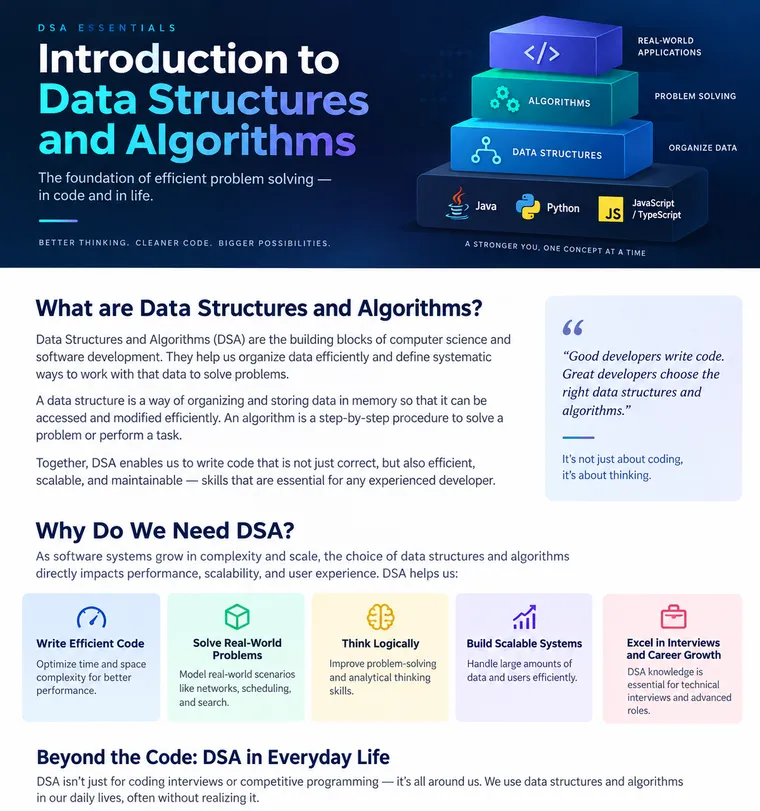
Introduction to DSA: The Foundation of Efficient Problem Solving
Introduction
When developers hear DSA — Data Structures and Algorithms, the first things that often come to mind are arrays, linked lists, trees, graphs, sorting, searching, and coding interviews.
But DSA is much bigger than a collection of programming techniques.
DSA is fundamentally about how we organize information and how we solve problems efficiently.
Every software application works with data.
A banking application works with:
- Customers
- Accounts
- Transactions
- Balances
- Payments
An e-commerce application works with:
- Products
- Customers
- Orders
- Payments
- Inventory
- Recommendations
A social media platform works with:
- Users
- Posts
- Followers
- Comments
- Likes
- Relationships
The interesting question is not simply:
“How do I store this data?”
The more important questions are:
“How should I organize this data?”
“How quickly can I access it?”
“How efficiently can I modify it?”
“How much memory will it consume?”
“What happens when the data grows from 1,000 records to 100 million records?”
This is where Data Structures and Algorithms become fundamental.
1. Before DSA: Understand Data
Let’s start with the smallest building block: data.
Data represents raw facts or values that a computer can process.
For example:
Name → HarshaAge → 30Salary → 150000City → HyderabadEach value represents data.
But storing individual values isn’t enough.
Real applications usually deal with large collections of related data.
Imagine an application containing:
10 usersManaging them manually is easy.
Now imagine:
10,000 usersThen:
10 million usersAnd eventually:
1 billion recordsThe problem changes completely.
We now need a systematic way to organize, access, update, search, and process that information.
That’s where data structures enter the picture.
2. What Is a Data Structure?
A data structure is a way of organizing and storing data so that operations on that data can be performed effectively.
A simple way to remember it is:
Data Structure ↓How should data be organized? ↓How should it be stored? ↓How should it be accessed? ↓How should it be modified?A useful real-life analogy is a recipe book.
Suppose a recipe book contains 2,000 recipes.
If all recipes were written randomly:
RecipeRecipeRecipeRecipeRecipeRecipe...Finding a particular recipe could become frustrating.
Instead, recipes might be organized as:
Recipe Book│├── Breakfast│ ├── Dosa│ ├── Idli│ └── Upma│├── Main Course│ ├── Biryani│ ├── Fried Rice│ └── Pasta│└── Desserts ├── Cake ├── Ice Cream └── Gulab JamunThe recipes are the data.
The organization is the structure.
This organization makes accessing information easier.
3. What Is an Algorithm?
If a data structure answers:
“How should I organize my data?”
then an algorithm answers:
“What steps should I follow to solve my problem?”
An algorithm is a finite sequence of well-defined steps used to solve a problem or perform a computation.
Consider making tea.
You could describe the process as:
1. Boil water2. Add tea leaves3. Add milk4. Add sugar5. Boil for some time6. Filter the tea7. ServeThat’s an algorithm.
The same idea exists in software.
For example:
Problem:Find the highest salary from a collection of employees.
Algorithm:1. Start with the first employee's salary.2. Compare it with the next salary.3. Keep the larger value.4. Continue until all employees are processed.5. Return the largest salary.
The implementation may differ between Java, Python, JavaScript, and TypeScript.
But the underlying problem-solving approach remains the same.
4. Data Structure + Algorithm = DSA
Now the relationship becomes clearer.
DSA │ ┌─────────┴─────────┐ │ │ Data Structures Algorithms │ │ Organize Data Process Data │ │ Arrays Searching Lists Sorting Trees Traversal Graphs Optimization Hash-based structures Problem solvingBut there is another important component:
Data ↓Data Structure ↓Algorithm ↓Program ↓ResultA program operates on data, and the way that data is organized directly influences how effectively the program can operate on it. Choosing an appropriate data structure can also improve readability, maintainability, and scalability.
This is why DSA shouldn’t be treated as two unrelated subjects.
Data structures and algorithms work together.
5. Why Do We Need DSA?
Imagine you have a contact list containing:
5 contactsAlmost any approach will feel fast.
Now imagine:
5 million contactsSuppose your application needs to repeatedly:
- Find a customer
- Add a customer
- Remove a customer
- Update customer information
- Find relationships between customers
- Process customers based on priority
The implementation decisions suddenly become extremely important.
The difference between two approaches might be milliseconds for small data but seconds, minutes, or even hours at much larger scales.
That’s why DSA matters.
The major benefits include:
1. Efficient data storage
DSA helps us organize data appropriately instead of storing everything in an arbitrary manner.
2. Faster processing
Good algorithms can significantly reduce the amount of work a computer needs to perform.
3. Better memory utilization
The choice of data structure affects how much memory is required.
4. Scalability
An application should continue to work effectively as its data and number of users increase.
5. Better problem-solving
DSA teaches developers how to break complicated problems into smaller, manageable pieces.
6. Maintainable software
Well-chosen structures and algorithms can make implementations easier to understand and evolve.
These are not merely interview benefits. Efficient data organization, scalability, problem solving, and resource optimization are core reasons DSA matters in software engineering.
6. DSA Is Not Just About Coding
One of the biggest misconceptions is:
“DSA is only required for coding interviews.”
That’s not true.
Interview preparation is one reason developers learn DSA, but the underlying concepts are used throughout software engineering.
Consider a simple requirement:
“Build a system that displays the next task that should be processed.”
The requirement immediately raises questions:
What determines the next task?
First task received?Highest priority?Shortest task?Nearest deadline?
Different requirements can lead to different data structures and algorithms.
For example:
Task Scheduling ↓How should tasks be organized? ↓What operation happens most frequently? ↓Choose suitable data structure ↓Design algorithm ↓Analyze performanceThis is DSA thinking.
7. DSA in Everyday Life
The most interesting thing about DSA is that you already use its principles every day.
You simply may not call them “data structures” or “algorithms.”
7.1 Contact List in Your Phone
Your phone may contain hundreds or thousands of contacts.
You expect to type:
"Rah..."and quickly see matching contacts.
Behind the interface, the system needs efficient ways to organize and retrieve information.
The general principle is:
Large amount of data ↓Organized representation ↓Efficient retrieval ↓Fast user experienceThis is exactly the kind of problem DSA helps us reason about.
8. Searching for a File
Imagine your laptop contains:
100,000 filesYou want:
project-report.pdfA naive approach would be:
Open file 1↓Not found
Open file 2↓Not found
Open file 3↓Not found
...
This becomes increasingly expensive as the number of files grows.
A well-designed system organizes metadata so that locating files becomes much more efficient.
The underlying principle is:
Good organization reduces unnecessary work.
That’s one of the central ideas behind DSA.
9. Navigation Applications
Consider a navigation application.
You want to travel from:
Location A ↓Location BBut there may be:
Thousands of roadsMillions of possible routesTraffic conditionsBlocked roadsDifferent distancesDifferent travel timesThe system must represent locations and connections and then determine an appropriate route.
Conceptually:
Locations ↓Relationships between locations ↓Possible routes ↓Algorithm ↓Best/appropriate routeThis type of problem naturally leads to graph-based thinking and pathfinding algorithms.
Graphs are particularly useful for representing relationships between entities and modeling networks and paths.
We will explore graphs and pathfinding in detail in a later article.
10. Social Media and Relationships
Consider a social network.
Suppose:
A follows BB follows CC follows DThe application needs to represent relationships between users.
Conceptually:
User A ───→ User B │ ↓ User C │ ↓ User DThis isn’t simply a list of users.
It is a relationship problem.
Graph structures are commonly used to model relationships between users and other entities.
11. Queues in the Real World
Think about standing in a queue at a bank.
Person A ↓Person B ↓Person C ↓Person DGenerally:
First person in ↓First person servedThis is the FIFO — First In, First Out principle.
Software systems use the same idea.
Examples include:
- Task processing
- Message processing
- Print jobs
- Request handling
- Scheduling
Queues are therefore not merely academic structures; they model very practical real-world behavior.
12. Stacks in Everyday Life
Think about a stack of plates.
Plate 3 ← added lastPlate 2Plate 1 ← added firstWhich plate do you normally remove first?
Plate 3This is:
LIFO — Last In, First Out.
The same concept appears in software systems such as:
- Function calls
- Expression evaluation
- Undo operations
- Navigation history
- Backtracking
Stacks are commonly used for function-call processing and expression evaluation.
13. Trees Around Us
Consider a company’s organizational structure:
CEO │ ┌─────────┴─────────┐ │ │ Manager A Manager B │ │ ┌───┴───┐ ┌───┴───┐ │ │ │ │ Dev QA Dev QAThis is naturally hierarchical.
Another example:
Computer │ ├── Documents │ ├── Work │ └── Personal │ ├── Downloads │ └── PicturesHierarchical data naturally maps to tree structures.
Trees are widely used to represent hierarchical information and are also important in searching and indexing.
14. DSA in Modern Software Systems
DSA appears across almost every major software domain.
| Domain | Example DSA Thinking |
|---|---|
| Search engines | Fast indexing and retrieval |
| Databases | Indexing and hierarchical organization |
| Social networks | Relationship modeling |
| Navigation | Graphs and pathfinding |
| Operating systems | Scheduling and resource management |
| Compilers | Trees, graphs, stacks |
| Networking | Graphs, queues, routing |
| E-commerce | Searching, ranking, recommendations |
| Gaming | Graphs, trees, pathfinding |
| Distributed systems | Queues, hashing, scheduling |
| Caching | Efficient lookup and eviction strategies |
| File systems | Hierarchical structures |
| AI/ML systems | Graphs, trees, optimization and search |
For example, hash-based structures can support fast indexing and retrieval, while trees can help organize and index data.
15. Why Does the Choice of Data Structure Matter?
Suppose we need to store:
1,000,000 customer recordsAnd our application frequently performs:
Search customerWe shouldn’t simply ask:
“Which data structure do I know?”
Instead ask:
“What operations does my application perform most frequently?”
For example:
Required operations ↓Search frequently?Insert frequently?Delete frequently?Maintain ordering?Process by priority?Represent relationships? ↓Analyze requirements ↓Choose suitable structureThis is an important transition from learning DSA to thinking like a software engineer.
16. DSA and Performance
Correctness is only one dimension of good software.
Consider two implementations:
Solution A → 10 operationsSolution B → 10,000,000 operationsIf both produce the correct result, they are functionally correct.
But they are not necessarily equally good engineering solutions.
As the input grows, the difference can become enormous.
That’s why we study algorithm complexity.
17. What Is Time Complexity?
Time complexity describes how the amount of computational work grows as the input size increases.
Suppose:
Input size = nWe are interested in how the work changes as:
n → largerFor example, conceptually:
10 records100 records1,000 records1,000,000 recordsThe key question is:
How does the algorithm’s work grow with n?
Time complexity is therefore about growth, rather than simply measuring the exact execution time on one computer.
18. What Is Space Complexity?
Algorithms also consume memory.
An algorithm might require:
Input data+Temporary variables+Additional data structures+Recursion/call stackSpace complexity helps us reason about how memory requirements grow with input size.
So algorithm analysis generally considers two important resources:
Algorithm │ ├── Time Complexity │ ↓ │ How computational work grows │ └── Space Complexity ↓ How memory usage growsUnderstanding the trade-off between time and space is an important part of designing scalable software. PPT - What is Time and Space Complexity (27Dec2025).pptxPPTX
We will study Big O notation, time complexity, space complexity, best/average/worst cases, and complexity analysis separately.
19. DSA and Scalability
Let’s look at a realistic scenario.
Imagine your application currently has:
1,000 usersEverything works perfectly.
Your application becomes successful.
Now you have:
100,000 usersThen:
10 million usersThen:
100 million usersA solution that worked beautifully at 1,000 users might become painfully slow at 100 million.
This is one of the biggest reasons experienced engineers care about algorithms and data structures.
Scalability changes the definition of “good code.”
Good code isn’t simply:
WorksIt should ideally be:
Correct+Efficient+Maintainable+ScalableEfficient algorithms reduce processing time and resource consumption, which directly contributes to better application performance.
20. DSA and Programming Languages
DSA is language-independent.
The concepts remain the same whether you implement them using:
Java
int[] numbers = {10, 20, 30, 40};Python
numbers = [10, 20, 30, 40]JavaScript
const numbers = [10, 20, 30, 40];TypeScript
const numbers: number[] = [10, 20, 30, 40];The syntax changes.
The underlying problem-solving concepts don’t.
This is why a developer who understands DSA deeply can transfer those skills between programming languages.
21. DSA Is More Important for Experienced Developers
There is an important difference between how a beginner and an experienced engineer should approach DSA.
A beginner may ask:
“How do I implement a stack?”
An experienced developer should eventually ask:
“Why do I need stack behavior here?”
A beginner may ask:
“How do I implement a tree?”
An experienced developer should ask:
“Does the problem actually have hierarchical relationships?”
A beginner may ask:
“Which algorithm should I use?”
An experienced developer should ask:
“What are my constraints, access patterns, performance requirements, and scalability expectations?”
This shift is critical.
DSA is not about memorizing implementations.
It is about developing the ability to recognize the structure of a problem.
22. From Requirements to DSA
Consider this requirement:
“Users should be able to undo their last actions.”
Instead of immediately writing code, think:
Requirement ↓What behavior is required? ↓Last action must be reversed first ↓LIFO behavior ↓Stack-like abstractionAnother requirement:
“Process requests in the order they arrive.”
Think:
Requirement ↓First request should be processed first ↓FIFO behavior ↓Queue-like abstractionAnother:
“Find a route between two locations.”
Think:
Locations + relationships ↓Graph-like model ↓Pathfinding algorithmThis is the essence of DSA thinking.
23. Logical Thinking Is the Real Skill
Learning DSA improves more than your ability to write code.
It teaches you to ask:
What is the actual problem?
What information do I have?
How is the information related?
What operations do I need?
What constraints exist?
What happens when the input becomes huge?
What is the simplest correct solution?
Can it be optimized?
What are the trade-offs?
This thought process is useful far beyond coding interviews.
It is useful when:
- Designing APIs
- Designing backend services
- Working with databases
- Building distributed systems
- Optimizing application performance
- Reviewing code
- Debugging production issues
- Designing scalable architectures
24. The DSA Mindset
A strong DSA mindset can be represented as:
Problem │ ↓ Understand Requirements │ ↓ Identify the Data │ ↓ Identify Relationships │ ↓ Identify Required Operations │ ↓ Choose Data Structure │ ↓ Design Algorithm │ ↓ Analyze Complexity │ ↓ Implement Code │ ↓ Test & OptimizeThis process is far more valuable than memorizing hundreds of solutions.
25. Common DSA Categories
At a high level, data structures can be viewed in different ways.
One useful distinction is:
Data Structures│├── Linear│ ├── Arrays│ ├── Linked Lists│ ├── Stacks│ └── Queues│└── Non-Linear ├── Trees ├── Graphs └── HeapsLinear structures organize elements sequentially, while non-linear structures allow more complex relationships.
Another perspective is:
Data Structures│├── Static└── DynamicStatic structures have a predetermined size, while dynamic structures can grow or shrink during execution.
And another useful distinction is:
Physical representation vsLogical organizationPhysical structures concern how data is represented in memory, whereas logical structures describe how data is conceptually organized and accessed. PPT - Types of Data Structures (26Dec2025).pptxPPTX
We will explore each category individually in future articles.
26. What Makes an Algorithm Good?
A good algorithm should have well-defined behavior.
Important characteristics include:
Finiteness
It should eventually terminate.
Definiteness
Each step should be clear and unambiguous.
Input
It can accept zero or more well-defined inputs.
Output
It should produce clearly defined results.
Generality
It should solve a class of problems rather than being designed only for one specific input. PPT - Introduction to Data Structures & Algorithm (26Dec2025).pptxPPTX
In real-world engineering, we additionally care about:
CorrectnessEfficiencyScalabilityMaintainabilityReadabilityResource usage27. DSA Is About Trade-offs
There is rarely a universally “best” data structure or algorithm.
Instead, there are usually trade-offs.
For example:
Faster access      ↕More memory
Less memory      ↕More computation
Fast insertion      ↕Fast random access
Simple implementation      ↕Advanced optimization
An experienced engineer doesn’t ask:
“What is the best data structure?”
They ask:
“What is the best data structure for this workload and these constraints?”
That’s a much more powerful question.
28. The Most Important Question: What Happens at Scale?
Whenever you design an algorithm, ask:
What happens if the input is:
10?
1,000?
100,000?
1 million?
100 million?
1 billion?
This question changes how you think about software.
For example:
Small input    ↓Almost any reasonable solution may work
Large input    ↓Efficiency becomes important
Very large input    ↓Data structure + algorithm choicebecomes critical
This is why DSA is closely connected to scalable software engineering.
29. DSA and Technical Interviews
DSA is also a major component of technical interviews because it provides a structured way to evaluate problem-solving ability.
Interviewers aren’t always interested only in whether you can write:
Java codePython codeJavaScript codeTypeScript codeThey often want to understand:
Can you understand the problem?
Can you identify constraints?
Can you choose an appropriate data structure?
Can you design an algorithm?
Can you explain your reasoning?
Can you analyze complexity?
Can you identify trade-offs?
Can you improve your solution?
These skills are valuable well beyond interviews.
30. What You Should Learn From DSA
After learning DSA properly, your goal shouldn’t be:
“I memorized 200 coding problems.”
Instead, your goal should be:
“I can look at an unfamiliar problem and reason about how to solve it efficiently.”
You should eventually be comfortable with:
Problem ↓Pattern ↓Data representation ↓Operations ↓Data structure ↓Algorithm ↓Complexity ↓ImplementationThat’s real DSA maturity.
31. DSA Learning Roadmap
For this DSA series, we can gradually move from fundamentals toward advanced problem solving.
DSA│├── 01. Introduction to DSA│├── 02. Complexity Analysis│ ├── Time Complexity│ ├── Space Complexity│ └── Big O│├── 03. Arrays│├── 04. Strings│├── 05. Searching│ ├── Linear Search│ └── Binary Search│├── 06. Sorting│├── 07. Linked Lists│├── 08. Stack│├── 09. Queue│├── 10. Hashing│├── 11. Recursion│├── 12. Trees│├── 13. Heaps│├── 14. Graphs│├── 15. Greedy Algorithms│├── 16. Backtracking│├── 17. Dynamic Programming│└── 18. Advanced Problem SolvingEach topic should eventually be understood from four perspectives:
Concept +Implementation +Complexity +Real-world applicationAnd implementations throughout the series can be demonstrated using:
Java + Python + JavaScript/TypeScript
32. Final Perspective
DSA is not simply a collection of arrays, linked lists, trees, graphs, sorting algorithms, and searching algorithms.
It is a way of thinking.
When you encounter a problem, DSA teaches you to stop and ask:
What data do I have?
How should I organize it?
What operations do I need?
What algorithm should process it?
How much time will it take?
How much memory will it consume?
Will it still work efficiently when the data grows?
That mindset is useful whether you’re building a small Python script, a Java backend service, a TypeScript application, or a large-scale distributed system.
The deeper lesson is simple:
Good software is not just about making a program work. It is about making the program work efficiently, predictably, and at scale.
And that is where Data Structures and Algorithms become one of the most important foundations of software engineering.
Key Takeaways
DSA│├── Data Structures│ → Organize data│├── Algorithms│ → Solve problems│├── Complexity│ → Measure growth of resource usage│├── Problem Solving│ → Break complex problems into manageable steps│└── Scalability → Build solutions that continue to work as data growsRemember these five principles:
- Data must be organized intentionally.
- Algorithms define how we process that data.
- The right data structure can dramatically change performance.
- Complexity matters when input size grows.
- DSA is ultimately about problem-solving, not memorization.