 Sho
ShoFunctional Programming with Java: From Traditional Loops to Composable Stream Pipelines
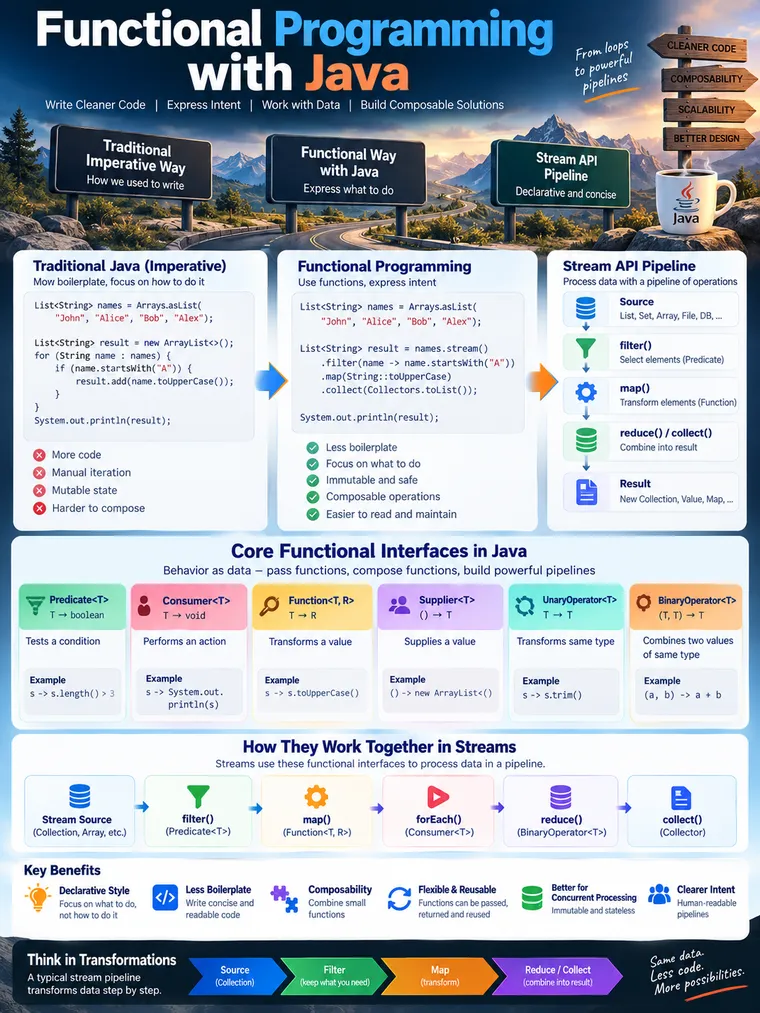
Functional Programming with Java: From Traditional Loops to Composable Stream Pipelines
A Practical Deep Dive into Lambdas, Functional Interfaces, Streams, Composition, and Modern Java
Java started its life primarily as an object-oriented programming language.
For many years, Java developers wrote code using classes, objects, loops, mutable variables, conditionals, and explicit control flow.
Then Java 8 changed the way Java developers could express problems.
Lambda expressions, functional interfaces, method references, and the Stream API introduced a more functional programming style into Java.
Suddenly, instead of focusing entirely on:
“How do I iterate through this collection?”
developers could express:
“What should happen to the elements that satisfy this condition?”
For example, traditional Java might look like:
List<String> result = new ArrayList<>();
for (String name : names) {    if (name.startsWith("A")) {        result.add(name.toUpperCase());    }}
Functional-style Java can express the same intention as:
List<String> result = names.stream() .filter(name -> name.startsWith("A")) .map(String::toUpperCase) .toList();The second version isn’t automatically “better” in every situation.
The important point is that Java now gives developers another way to express computation.
That is the real importance of functional programming in Java.
1. What Is Functional Programming?
Functional programming is a programming style in which computation is expressed primarily through functions and transformations of values.
Instead of thinking primarily in terms of:
objectsstateloopsmutationsinstructionsfunctional programming encourages thinking in terms of:
valuesfunctionstransformationscompositionexpressionsdata flowA simplified model is:
Input ↓Function ↓Transformation ↓Function ↓OutputFor example:
Function<Integer, Integer> square = x -> x * x;
System.out.println(square.apply(5));
Output:
25The function receives a value and produces another value.
2. Functional Programming Does Not Mean “Never Use Loops”
This is an important distinction for experienced Java developers.
Functional programming is a programming paradigm/style, not a rule that says:
“Loops are forbidden.”
Java remains a multi-paradigm language.
You can use:
- Object-oriented programming
- Imperative programming
- Functional programming
- Generic programming
- Declarative techniques
in the same application.
Good Java engineering is about selecting the appropriate approach.
A simple loop can sometimes be clearer than a complicated stream pipeline.
The goal isn’t:
“Replace every loop with a stream.”
The goal is:
Express the problem in the clearest and most maintainable way.
3. Why Was Functional Programming Added to Java?
Before Java 8, passing behavior into a method was considerably more verbose.
Suppose we want to filter employees based on different conditions.
Traditional approaches often resulted in separate methods or classes.
For example:
List<Employee> findSeniorEmployees(List<Employee> employees) {    // filtering logic}
List<Employee> findHighSalaryEmployees(List<Employee> employees) {    // another filtering logic}
The actual operation is the same:
Filter employeesOnly the condition changes.
Functional programming allows us to pass the behavior.
Predicate<Employee> condition =        employee -> employee.getSalary() > 100000;
employees.stream()        .filter(condition)        .toList();
Now the filtering operation and the filtering rule are separate.
This idea is called behavior parameterization.
4. Behavior Parameterization
Behavior parameterization is one of the most important ideas behind functional programming in Java.
Instead of passing only data:
process(employee);we can pass behavior:
process(employee, employee -> employee.getSalary() > 100000);The method becomes reusable.
For example:
static List<Employee> filterEmployees(        List<Employee> employees,        Predicate<Employee> condition) {
    return employees.stream()            .filter(condition)            .toList();}
Now we can provide different behaviors:
filterEmployees( employees, employee -> employee.getSalary() > 100000);or:
filterEmployees( employees, employee -> employee.getDepartment().equals("IT"));or:
filterEmployees( employees, employee -> employee.getExperience() >= 10);The method doesn’t change.
Only the behavior changes.
That is powerful API design.
5. Functional Programming vs Traditional Programming
Consider a simple problem.
Find all numbers greater than 10 and double them.
Traditional approach
List<Integer> result = new ArrayList<>();
for (Integer number : numbers) {
    if (number > 10) {        result.add(number * 2);    }}
We explicitly describe:
- Create a result list
- Iterate
- Read an element
- Check condition
- Modify result
- Continue
Functional approach
List<Integer> result = numbers.stream() .filter(number -> number > 10) .map(number -> number * 2) .toList();We describe:
numbers ↓filter ↓map ↓resultThis is a major conceptual difference.
6. Lambda Expressions
A lambda expression is a concise way to represent behavior.
The general form is:
(parameters) -> expressionExample:
x -> x * 2Multiple parameters:
(a, b) -> a + bBlock body:
x -> { int result = x * 2; return result;}No parameters:
() -> "Hello"A lambda by itself doesn’t tell Java what type of function it represents.
The target type comes from the functional interface.
For example:
Function<Integer, Integer> square = x -> x * x;Here Java knows:
Input = IntegerOutput = Integerbecause Function<Integer, Integer> defines the expected shape.
7. What Is a Functional Interface?
A functional interface is an interface with exactly one abstract method.
Example:
@FunctionalInterfaceinterface Calculator {
    int calculate(int a, int b);}
We can provide its implementation using a lambda:
Calculator add = (a, b) -> a + b;Then:
System.out.println(add.calculate(10, 20));Output:
30The @FunctionalInterface annotation isn’t strictly required for the compiler to recognize a valid functional interface, but it communicates design intent and lets the compiler detect accidental violations.
8. Lambda + Functional Interface
Think about the relationship this way:
Functional Interface ↓Defines the shape ↓Lambda ↓Provides the behaviorExample:
Predicate<String> predicate = text -> text.length() > 5;Predicate defines:
T → booleanThe lambda provides:
text → text.length() > 59. The Core Functional Interfaces
Java’s java.util.function package provides common reusable functional interfaces.
The most important ones are:
| Interface | Input | Output | Purpose |
|---|---|---|---|
Predicate<T> | T | boolean | Test a condition |
Consumer<T> | T | void | Perform an action |
Function<T,R> | T | R | Transform a value |
Supplier<T> | none | T | Produce a value |
UnaryOperator<T> | T | T | Transform same type |
BinaryOperator<T> | T,T | T | Combine two same-type values |
BiFunction<T,U,R> | T,U | R | Combine two inputs |
BiPredicate<T,U> | T,U | boolean | Test two inputs |
BiConsumer<T,U> | T,U | void | Consume two inputs |
10. Predicate
A Predicate<T> represents a boolean-valued test.
Conceptually:
T → booleanExample:
Predicate<Integer> even = number -> number % 2 == 0;Usage:
System.out.println(even.test(10));Output:
truePredicate is heavily used with:
filter()removeIf()anyMatch()allMatch()noneMatch()11. Consumer
A Consumer<T> accepts a value and returns nothing.
Conceptually:
T → voidExample:
Consumer<String> printer = text -> System.out.println(text);Usage:
printer.accept("Java");The standard Consumer contract is specifically designed for an operation that accepts one input and returns no result.
Common usage:
list.forEach(System.out::println);Here:
forEach() ↓Consumer12. Function
Function<T,R> accepts one value and returns another value.
Conceptually:
T → RExample:
Function<String, Integer> length = text -> text.length();Usage:
System.out.println(length.apply("Java"));Output:
4Functions are commonly used with:
map()mapToInt()groupingBy()collect()13. Supplier
A Supplier<T> takes no input and produces a value.
Conceptually:
() → TExample:
Supplier<Double> randomValue = () -> Math.random();Usage:
System.out.println(randomValue.get());Supplier is useful for:
- Lazy creation
- Factory methods
- Default values
- Generating values
- Deferred execution
14. UnaryOperator
UnaryOperator<T> accepts one value and returns the same type.
Conceptually:
T → TExample:
UnaryOperator<Integer> square = number -> number * number;Input:
5Output:
25The important difference from Function is the type relationship.
Function<Integer, String>can transform:
Integer → Stringwhereas:
UnaryOperator<Integer>must be:
Integer → Integer15. BinaryOperator
BinaryOperator<T> accepts two values of the same type and returns the same type.
Conceptually:
(T, T) → TExample:
BinaryOperator<Integer> addition = (a, b) -> a + b;Usage:
System.out.println(addition.apply(10, 20));Output:
30Binary operators are particularly important in reduction operations.
For example:
numbers.stream() .reduce(0, Integer::sum);Conceptually:
value + value → value16. How the Functional Interfaces Work Together
Consider this stream:
numbers.stream() .filter(n -> n % 2 == 0) .map(n -> n * n) .forEach(System.out::println);There are different behaviors in the pipeline.
filter
Uses:
Predicate<T>T → booleanmap
Uses:
Function<T,R>T → RforEach
Uses:
Consumer<T>T → voidSo:
Stream ↓filter(Predicate) ↓map(Function) ↓forEach(Consumer)This is one of the most important mental models for understanding Java Streams.
17. Stream API: The Complete Mental Model
A stream pipeline generally consists of:
SOURCE ↓INTERMEDIATE OPERATIONS ↓TERMINAL OPERATIONFor example:
numbers.stream() .filter(n -> n > 10) .map(n -> n * 2) .sorted() .toList();Source
numbers.stream()Intermediate operations
filter()map()sorted()Terminal operation
toList()Streams are lazy: intermediate operations generally don’t execute until a terminal operation starts the computation. Streams also don’t store data themselves; they describe a computation over a source.
18. Stream Operations You Must Know
For an experienced Java developer, learning only filter(), map() and forEach() is not enough.
You should understand:
Filtering
filter()Transformation
map()mapToInt()mapToLong()mapToDouble()Flattening
flatMap()flatMapToInt()flatMapToLong()flatMapToDouble()Ordering
sorted()Deduplication
distinct()Limiting
limit()skip()takeWhile()dropWhile()Matching
anyMatch()allMatch()noneMatch()Finding
findFirst()findAny()Reduction
reduce()Collection
collect()toList()toSet()toMap()groupingBy()partitioningBy()joining()Iteration
forEach()forEachOrdered()Debugging
peek()Primitive streams
IntStreamLongStreamDoubleStream19. map() vs flatMap()
This is a very important interview topic.
Suppose:
List<List<Integer>> numbers = List.of( List.of(1, 2), List.of(3, 4), List.of(5, 6) );Using map():
numbers.stream() .map(List::stream);gives:
Stream<Stream<Integer>>But flatMap() flattens the nested streams:
numbers.stream() .flatMap(List::stream) .toList();Result:
[1, 2, 3, 4, 5, 6]Think:
map1 → 1 result
flatMap1 → many results
20. reduce()
Reduction combines many values into one result.
Example:
int sum = numbers.stream() .reduce(0, Integer::sum);Conceptually:
0 ↓0 + 1 ↓1 + 2 ↓3 + 3 ↓6 + 4 ↓...Reduction is particularly important when understanding parallel stream processing because the reduction operation needs appropriate associativity and identity characteristics.
21. collect() vs reduce()
Don’t treat them as interchangeable.
reduce() generally produces a single reduced value.
int sum = numbers.stream() .reduce(0, Integer::sum);collect() is designed for mutable/result accumulation through a Collector.
List<Integer> result = numbers.stream() .filter(n -> n > 10) .collect(Collectors.toList());Modern Java also provides:
.toList()for collecting into an unmodifiable list.
22. Collectors: An Essential Advanced Topic
For experienced developers, the Stream API is incomplete without understanding Collectors.
Important collectors include:
toList()toSet()toMap()joining()counting()summarizingInt()averagingInt()groupingBy()partitioningBy()mapping()filtering()flatMapping()collectingAndThen()reducing()For example:
Map<String, List<Employee>> employeesByDepartment = employees.stream() .collect( Collectors.groupingBy( Employee::getDepartment ) );This is effectively:
GROUP BY departmentin SQL-like thinking.
The Java API’s groupingBy collector classifies elements using a function and creates a map of grouped results.
23. partitioningBy()
partitioningBy() creates two groups based on a boolean predicate.
For example:
Map<Boolean, List<Integer>> result = numbers.stream() .collect( Collectors.partitioningBy( n -> n % 2 == 0 ) );Conceptually:
true → even numbersfalse → odd numbersThis is different from groupingBy() because partitioning is specifically based on a boolean condition.
24. Method References
Sometimes a lambda simply calls an existing method.
Instead of:
name -> name.toUpperCase()we can write:
String::toUpperCaseInstead of:
number -> System.out.println(number)we can write:
System.out::printlnMethod references improve readability when the method already expresses the required behavior.
25. Function Composition
One of the more advanced functional programming concepts in Java is function composition.
Suppose:
Function<String, String> trim =        String::trim;
Function<String, String> upper =        String::toUpperCase;
We can compose them:
Function<String, String> pipeline = trim.andThen(upper);Now:
pipeline.apply(" java ");produces:
JAVAThis gives us:
input ↓trim ↓uppercase ↓outputSmall functions become reusable building blocks.
26. Predicate Composition
Predicates can also be combined.
Predicate<Integer> positive =        n -> n > 0;
Predicate<Integer> even =        n -> n % 2 == 0;
Combine them:
Predicate<Integer> positiveEven = positive.and(even);Or:
Predicate<Integer> positiveOrEven = positive.or(even);Or:
Predicate<Integer> notPositive = positive.negate();This is another example of treating behavior as composable data.
27. 30 Practical Functional Programming Programs
The following exercises are deliberately designed for an experienced Java developer.
Don’t just run them.
For every example, ask:
What functional interface is being used?What is the input?What is the output?Is the operation lazy?Is there a side effect?Can this be composed?Would a loop be clearer?What happens with parallel execution?Program 1 — Predicate: Check Even Number
Predicate<Integer> even =        n -> n % 2 == 0;
System.out.println(even.test(20));
Program 2 — Predicate: Check String Length
Predicate<String> longText =        text -> text.length() > 10;
System.out.println(longText.test("Functional Java"));
Program 3 — Predicate Composition
Predicate<Integer> positive =        n -> n > 0;
Predicate<Integer> even =        n -> n % 2 == 0;
Predicate<Integer> positiveEven =        positive.and(even);
System.out.println(positiveEven.test(10));
Program 4 — Predicate OR
Predicate<String> startsWithA =        text -> text.startsWith("A");
Predicate<String> startsWithB =        text -> text.startsWith("B");
Predicate<String> startsWithAOrB =        startsWithA.or(startsWithB);
System.out.println(startsWithAOrB.test("Java"));
Program 5 — Predicate Negation
Predicate<Integer> even =        n -> n % 2 == 0;
Predicate<Integer> odd =        even.negate();
System.out.println(odd.test(7));
Program 6 — Consumer
Consumer<String> printer =        text -> System.out.println(text);
printer.accept("Hello Java");
Program 7 — Consumer Chaining
Consumer<String> print =        System.out::println;
Consumer<String> log =        text -> System.out.println("LOG: " + text);
Consumer<String> combined =        print.andThen(log);
combined.accept("Functional Programming");
Program 8 — Function
Function<String, Integer> length =        String::length;
System.out.println(length.apply("Java"));
Program 9 — Function Transformation
Function<Integer, Integer> square =        n -> n * n;
System.out.println(square.apply(10));
Program 10 — Function Composition
Function<String, String> trim =        String::trim;
Function<String, String> upper =        String::toUpperCase;
Function<String, String> pipeline =        trim.andThen(upper);
System.out.println(        pipeline.apply("  java  "));
Program 11 — Function compose()
Function<Integer, Integer> multiplyByTwo =        n -> n * 2;
Function<Integer, Integer> addTen =        n -> n + 10;
Function<Integer, Integer> result =        multiplyByTwo.compose(addTen);
System.out.println(result.apply(5));
The order of compose() and andThen() is an important interview topic.
Program 12 — Supplier
Supplier<String> supplier =        () -> "Generated Value";
System.out.println(supplier.get());
Program 13 — Supplier for Lazy Object Creation
Supplier<List<String>> listSupplier =        ArrayList::new;
List<String> list = listSupplier.get();
list.add("Java");
System.out.println(list);
Program 14 — UnaryOperator
UnaryOperator<Integer> square =        n -> n * n;
System.out.println(        square.apply(5));
Program 15 — UnaryOperator for String Transformation
UnaryOperator<String> normalize =        text -> text.trim().toLowerCase();
System.out.println(        normalize.apply("  JAVA  "));
Program 16 — BinaryOperator
BinaryOperator<Integer> add =        (a, b) -> a + b;
System.out.println(        add.apply(10, 20));
Program 17 — BinaryOperator Maximum
BinaryOperator<Integer> max =        Integer::max;
System.out.println(        max.apply(10, 25));
Program 18 — BiFunction
BiFunction<Integer, Integer, Integer> multiply =        (a, b) -> a * b;
System.out.println(        multiply.apply(10, 20));
Program 19 — BiPredicate
BiPredicate<String, String> sameLength =        (a, b) -> a.length() == b.length();
System.out.println(        sameLength.test("Java", "Code"));
Program 20 — BiConsumer
BiConsumer<String, Integer> printer =        (name, age) ->                System.out.println(name + " : " + age);
printer.accept("Harsha", 30);
Program 21 — Stream Filter
List<Integer> numbers =        List.of(1, 2, 3, 4, 5, 6);
List<Integer> evenNumbers =        numbers.stream()                .filter(n -> n % 2 == 0)                .toList();
System.out.println(evenNumbers);
Program 22 — Stream Map
List<Integer> squares =        numbers.stream()                .map(n -> n * n)                .toList();
System.out.println(squares);
Program 23 — Filter + Map
List<Integer> result =        numbers.stream()                .filter(n -> n > 3)                .map(n -> n * n)                .toList();
System.out.println(result);
Program 24 — Reduce
int sum =        numbers.stream()                .reduce(0, Integer::sum);
System.out.println(sum);
Program 25 — Find Maximum
int max =        numbers.stream()                .reduce(Integer.MIN_VALUE,                        Integer::max);
System.out.println(max);
Program 26 — Distinct + Sorted
List<Integer> result =        List.of(5, 2, 3, 2, 5, 1)                .stream()                .distinct()                .sorted()                .toList();
System.out.println(result);
Program 27 — FlatMap
List<List<Integer>> nested =        List.of(                List.of(1, 2),                List.of(3, 4),                List.of(5, 6)        );
List<Integer> flattened =        nested.stream()                .flatMap(List::stream)                .toList();
System.out.println(flattened);
Program 28 — Grouping
Map<Integer, List<String>> grouped =        List.of(                "Java",                "Spring",                "Python",                "Docker",                "AWS"        )        .stream()        .collect(                Collectors.groupingBy(                        String::length                )        );
System.out.println(grouped);
Program 29 — Partitioning
Map<Boolean, List<Integer>> partitioned =        numbers.stream()                .collect(                        Collectors.partitioningBy(                                n -> n % 2 == 0                        )                );
System.out.println(partitioned);
Program 30 — Complete Functional Pipeline
List<String> result =        List.of(                "java",                "spring",                "docker",                "aws",                "javascript"        )        .stream()        .filter(text -> text.length() > 4)        .map(String::toUpperCase)        .sorted()        .toList();
System.out.println(result);
This small example combines:
Source ↓Predicate ↓Function ↓Comparator ↓Terminal operationThat is functional programming in action.
28. More Stream Topics an Experienced Developer Should Learn
If you want this topic to be genuinely useful for a 8–10+ year Java developer, don’t stop at the common tutorials.
Add these topics to your learning list.
Stream lifecycle
Source ↓Intermediate operations ↓Terminal operationLaziness
Understand exactly when code executes.
Short-circuiting
Learn:
findFirst()findAny()anyMatch()allMatch()noneMatch()limit()Stateful intermediate operations
Understand:
sorted()distinct()and why they differ from stateless operations.
Primitive streams
Learn:
IntStreamLongStreamDoubleStreamand:
mapToInt()mapToLong()mapToDouble()boxed()Infinite streams
Learn:
Stream.iterate()Stream.generate()with:
limit()Collectors
Deep dive into:
groupingBy()partitioningBy()toMap()joining()mapping()filtering()flatMapping()collectingAndThen()reducing()Optional
Understand how Optional interacts with functional-style programming.
Parallel streams
Understand:
parallelStream()and more importantly:
When NOT to use it.
Side effects
Understand why code such as:
List<Integer> result = new ArrayList<>();
numbers.parallelStream()        .forEach(result::add);
is dangerous.
Stream reuse
A stream cannot generally be consumed twice.
Stream<Integer> stream =        numbers.stream();
stream.count();
stream.forEach(System.out::println);
The second terminal operation fails because the stream has already been consumed.
29. peek() Is Not a Replacement for forEach()
This is a common mistake.
peek() is primarily useful for observing elements as they flow through a pipeline, particularly while debugging.
For example:
numbers.stream() .filter(n -> n > 5) .peek(System.out::println) .map(n -> n * 2) .toList();Don’t use peek() as the primary mechanism for business side effects.
Prefer:
forEach()when you intentionally need a terminal side effect.
30. Functional Programming and Immutability
Functional programming generally encourages minimizing mutable state.
Compare:
int total = 0;
for (Integer number : numbers) {    total += number;}
with:
int total = numbers.stream() .reduce(0, Integer::sum);The second version expresses the computation as a reduction.
This becomes especially interesting when thinking about concurrency.
Less shared mutable state generally means fewer opportunities for synchronization problems.
But don’t make the mistake of believing:
“Streams automatically make code thread-safe.”
They don’t.
Functional style can help reduce certain categories of shared-state problems, but correctness still depends on the operations you perform.
31. Functional Programming and Parallelism
One motivation behind Java Streams was to provide a model that can support sequential and parallel processing.
For example:
numbers.stream()versus:
numbers.parallelStream()However:
Parallelism is not automatically faster.
Parallel execution introduces:
- Thread management
- Splitting overhead
- Coordination
- Merging results
- Memory overhead
- Ordering considerations
- Contention
A small collection can actually become slower when processed in parallel.
Therefore:
parallelStream()should not be treated as:
performanceStream()The decision should be based on workload characteristics and measurement.
32. Functional Programming in Real Spring Boot Applications
Functional programming isn’t limited to toy examples.
Consider a Spring Boot service:
public List<CustomerResponse> getActiveCustomers() {
    return customerRepository.findAll()            .stream()            .filter(Customer::isActive)            .map(customerMapper::toResponse)            .sorted(Comparator.comparing(                    CustomerResponse::name            ))            .toList();}
This pipeline expresses:
Database result ↓Active customers ↓Convert domain object ↓Sort ↓Return responseThis is much closer to the business operation than manually managing temporary lists.
33. Functional Programming in Data Processing
Suppose an order service receives:
100,000 ordersWe might want:
Only completed orders ↓Extract amount ↓Group by customer ↓Calculate totalsFunctional-style thinking naturally maps to:
orders.stream() .filter(Order::isCompleted) .collect( Collectors.groupingBy( Order::getCustomerId, Collectors.summingDouble( Order::getAmount ) ) );This is where functional programming becomes more than syntax.
It becomes a way of expressing data transformation.
34. Functional Interfaces Beyond Java
Your question about whether functional interfaces exist in other programming languages is important.
The exact Java concept called FunctionalInterface is Java-specific, but the underlying idea is widespread.
Different languages solve the same problem differently.
Java
Java uses:
PredicateConsumerFunctionSupplierUnaryOperatorBinaryOperatorplus custom functional interfaces.
C#
C# uses delegates and built-in delegate types such as:
Func<>Action<>Predicate<>and lambda expressions.
For example:
Func<int, int> square = x => x * x;C# documentation describes lambdas as compact inline functions and provides Func and Action delegate families for common function shapes.
JavaScript
JavaScript treats functions as first-class values.
You can:
const square = x => x * x;pass functions to other functions:
numbers.map(x => x * 2);and return functions from functions.
JavaScript’s arrow functions provide concise function syntax, while functions can be passed around as values.
Python
Python also supports functional programming through first-class callable objects and tools such as:
map()filter()lambdafunctoolsitertoolsoperatorPython’s standard library explicitly provides modules supporting a functional programming style, including itertools, functools, and operator.
So the underlying concept is not unique to Java.
What is distinctive in Java is the particular combination of:
Functional Interface +Lambda +Method Reference +Stream API +Collectors35. The Real Difference Between Traditional and Functional Thinking
Traditional imperative thinking often asks:
What steps should the computer execute?
Functional thinking asks:
What transformation should happen to the data?
For example:
Imperative thinking
Create listLoopCheck conditionModify listLoop againSortPrintFunctional thinking
Source ↓Filter ↓Transform ↓Sort ↓CollectNeither is universally superior.
The second model becomes particularly powerful when the problem is naturally expressed as a sequence of transformations.
36. Functional Programming Is Not Just “Shorter Code”
This is one of the biggest misconceptions.
This:
list.stream() .filter(...) .map(...) .filter(...) .map(...) .flatMap(...) .sorted(...) .collect(...);is not necessarily better simply because it contains fewer lines.
Functional programming should provide:
- Better separation of behavior
- Composability
- Reusability
- Clearer data flow
- Reduced accidental mutation
- Better abstraction
- More expressive APIs
If a stream becomes difficult to understand, a traditional loop may be the better engineering decision.
37. What an Experienced Java Developer Should Be Able to Explain
For interviews and real-world development, don’t stop at:
“I know Java Streams.”
You should be able to explain:
Lambda
How is a lambda represented and used by Java?
Functional interface
Why does Java need a target type for a lambda?
Predicate
Why does filter() use a predicate?
Function
Why does map() use a function?
Consumer
Why does forEach() use a consumer?
Supplier
Where would lazy value creation be useful?
UnaryOperator
Why is it different from Function<T,T> conceptually?
BinaryOperator
Why is it useful in reductions?
Stream
Why doesn’t a stream store elements?
Laziness
Why doesn’t filter() execute immediately?
map() vs flatMap()
What is the cardinality difference?
reduce() vs collect()
When should each be used?
Sequential vs parallel
When can parallel execution hurt performance?
Side effects
Why can mutable state cause problems in stream pipelines?
Collectors
How does groupingBy() work?
Function composition
How can functions be combined?
These are the questions that separate syntax knowledge from engineering understanding.
38. A Practical Learning Order
For someone already experienced with Java, learn functional programming in this sequence:
1. Imperative vs Functional Thinking ↓2. Lambda Expressions ↓3. Functional Interfaces ↓4. Predicate ↓5. Consumer ↓6. Function ↓7. Supplier ↓8. UnaryOperator ↓9. BinaryOperator ↓10. Method References ↓11. Stream Basics ↓12. filter / map ↓13. sorted / distinct ↓14. flatMap ↓15. reduce ↓16. collect ↓17. Collectors ↓18. groupingBy / partitioningBy ↓19. Optional ↓20. Primitive Streams ↓21. Infinite Streams ↓22. Function Composition ↓23. Predicate Composition ↓24. Side Effects ↓25. Parallel Streams ↓26. Real-world Spring Boot usage39. Final Perspective
Functional programming didn’t replace object-oriented programming in Java.
It expanded what Java developers can express.
The most important change isn’t the syntax:
x -> x * 2The important change is the mental model behind it:
Behavior can be represented as data.Behavior can be passed around.Behavior can be composed.Data can flow through transformations.Once you understand that, APIs such as:
filter()map()flatMap()reduce()collect()groupingBy()partitioningBy()stop looking like unrelated methods.
They become building blocks for expressing computation.
And functional interfaces stop looking like six interfaces you need to memorize.
They become different shapes of behavior:
PredicateT → boolean
ConsumerT → void
FunctionT → R
Supplier() → T
UnaryOperatorT → T
BinaryOperator(T, T) → T
That is the foundation.
The Stream API is simply where these ideas become visible in everyday Java development.
Final Thought
A developer who only learns:
filter()map()forEach()knows how to use streams.
A developer who understands:
behavior parameterization+functional interfaces+lambdas+composition+lazy evaluation+immutability+collectors+reduction+parallelism+trade-offsunderstands functional programming in Java.
And that distinction matters.
Because modern Java development is no longer just about knowing how to write code.
It is about being able to express behavior, data transformations, and business rules clearly and safely.
Don’t learn Functional Programming merely to replace loops. Learn it to change the way you think about computation.