 Sho
Sho1. Spring Boot : Understanding the Real Problem Spring Boot Solves
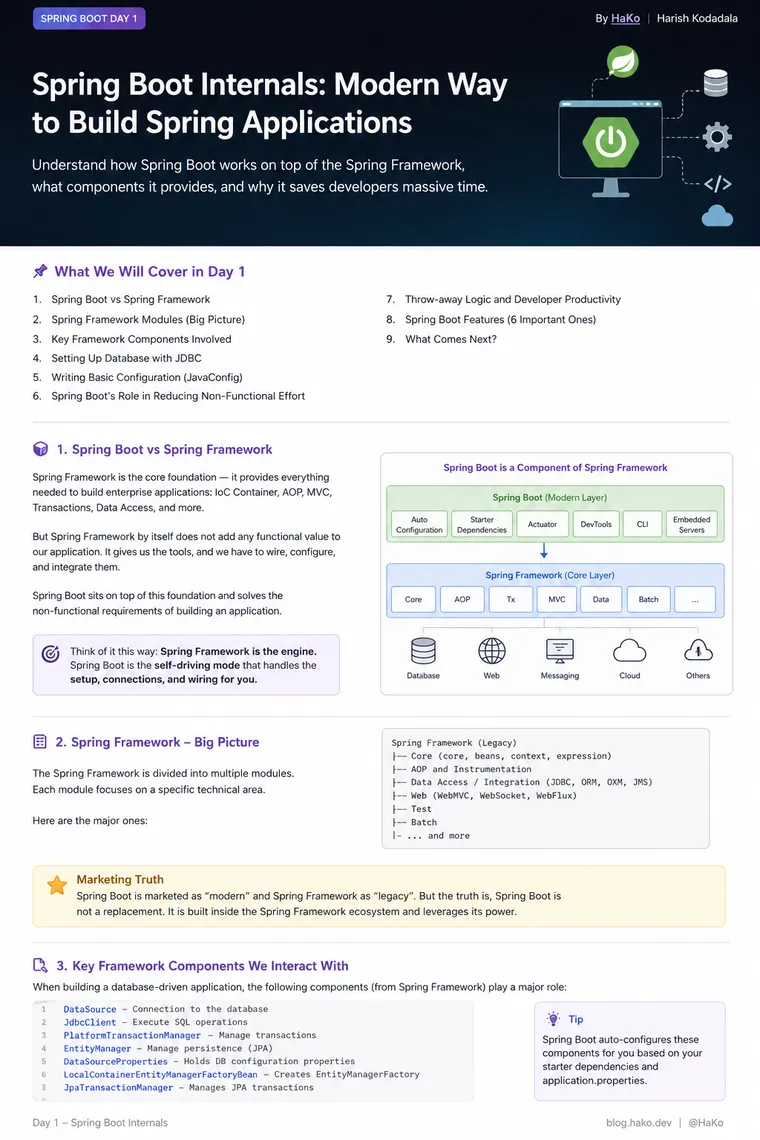
Spring Boot : Understanding What Spring Boot Really Does
Experience Level: Intermediate Java Developers
Category: Spring Boot
Prerequisites: Core Java and basic understanding of Spring Framework
When developers start learning Spring Boot, the first thing they usually encounter is a collection of annotations, starters, configuration files, and commands.
But memorizing these features doesn’t explain the most important question:
What problem was Spring Boot actually designed to solve?
To understand Spring Boot properly, we first need to understand the relationship between Spring Framework, application infrastructure, configuration, and business logic.
Spring Framework Is the Foundation
The Spring Framework provides a large set of capabilities that help developers build enterprise applications.
Depending on the type of application, we may use different parts of the Spring ecosystem:
- Dependency Injection and IoC
- AOP
- Transaction management
- JDBC
- Web/MVC
- Data access
- Testing
- Batch processing
- Messaging
- Security
- and many others
Think of Spring Framework as a toolbox.
It provides the tools required to build an application, but having the tools doesn’t automatically mean the complete application is configured and ready to run.
For example, if an application needs database access, several infrastructure components may need to work together.
Application | +---- Database Access | +---- DataSource | +---- Transactions | +---- Database Driver | +---- ConfigurationThe developer needs to assemble these pieces correctly.
That is where the complexity begins.
The Real Problem: Application Infrastructure
Imagine that your requirement is very simple:
“Create an application that stores customer information in a database.”
The actual business functionality might be:
Receive Customer ↓Validate Customer ↓Save Customer ↓Return ResponseBut the application also needs infrastructure to make this possible.
For example:
Application ↓Database Configuration ↓DataSource ↓Database Connection ↓Transaction Management ↓Database AccessNone of those infrastructure components represent the actual Customer business requirement.
They are necessary to make the application work.
This distinction is extremely important.
Business logic
Business logic answers:
What does my application actually do?
Examples:
- Calculate loan interest
- Place an order
- Process a payment
- Calculate shipping cost
- Validate an insurance claim
Infrastructure
Infrastructure answers:
What does the application need in order to run that business logic?
Examples:
- Database connections
- Transactions
- Web server
- Security configuration
- Dependency injection
- Logging
- Monitoring
Spring Boot is largely about making this second area easier.
Why Configuration Became a Problem
Spring is powerful because it provides many configurable components.
But flexibility can also create complexity.
Suppose an application needs database access.
The developer may need to deal with:
Database Driver ↓DataSource ↓Database Access ↓Transaction ManagementIf JPA is involved, additional infrastructure appears:
Repository ↓EntityManager ↓EntityManagerFactory ↓DataSource ↓DatabaseNow imagine doing this for:
- Web
- Database
- JPA
- Transactions
- Security
- Messaging
- Monitoring
The amount of configuration can grow quickly.
The developer may spend a significant amount of time telling the framework how to assemble components, rather than implementing the application’s actual business requirements.
Dependency Management Is Another Challenge
Modern Java applications rarely depend on a single library.
For example, adding database functionality may bring several related libraries into the application.
Those libraries may themselves depend on other libraries.
This creates a dependency graph:
Application | +--- Spring Data | | | +--- Spring Framework | +--- Database Driver | +--- ORM | +--- Supporting LibrariesThe problem isn’t simply downloading these libraries.
The difficult part is maintaining compatible versions.
If you manually manage a large dependency graph, you need to understand:
- Which dependency is required?
- Which version should be used?
- Are the versions compatible?
- Which transitive dependencies are required?
- What happens when one dependency is upgraded?
Spring Boot significantly simplifies this area through its dependency-management approach and starter dependencies.
Spring Boot Is Not a Replacement for Spring Framework
This is one of the most important concepts to understand.
You may sometimes hear:
“Spring Framework is legacy and Spring Boot is modern.”
This is an oversimplification.
It is better to understand the relationship like this:
Spring Boot | ↓ Simplifies Application Setup & Configuration | ↓ Spring Framework | ↓ Core Spring CapabilitiesSpring Boot uses Spring Framework.
It doesn’t make Spring Framework unnecessary.
In fact, when you build a Spring Boot application, you are still using fundamental Spring concepts such as:
- IoC
- Dependency Injection
- Beans
- Application Context
- AOP
- Transactions
- Spring MVC
- Spring Data
So don’t learn:
Spring = OldSpring Boot = NewLearn:
Spring Framework = Foundation
Spring Boot = Easier way to build applications               using that foundation
That mental model will help you throughout your Spring Boot career.
What Does Spring Boot Actually Improve?
Spring Boot primarily reduces the amount of manual infrastructure configuration required to start and run a Spring application.
Instead of manually configuring every component, Spring Boot can make decisions based on the application’s environment.
For example:
Dependencies +Configuration +Existing Beans ↓Spring Boot ↓Auto-Configuration ↓Application InfrastructureThis doesn’t mean that Spring Boot randomly creates objects.
It uses predefined configuration and conditions to determine which infrastructure should be configured.
Auto-Configuration: The Key Idea
Auto-configuration is one of the most important concepts in Spring Boot.
Suppose your application contains the dependencies required for a particular capability.
Spring Boot can detect those dependencies and apply appropriate configuration.
For example:
Database Dependency +Database Configuration ↓Spring Boot ↓Database InfrastructureInstead of manually creating and wiring every supporting component, Boot can provide sensible defaults.
However, auto-configuration is conditional.
It doesn’t mean:
“Spring Boot knows everything about my application.”
It means:
“Spring Boot can automatically configure common infrastructure when certain conditions are satisfied.”
And when the defaults aren’t suitable, developers can customize or replace them.
Starter Dependencies
Another major Spring Boot concept is the starter.
Imagine that you want to build a web application.
Instead of manually searching for every library required for common Spring web development, you can use an appropriate starter.
Conceptually:
Starter ↓Related Dependencies ↓Required Spring InfrastructureThe benefit is simplicity.
You express the capability your application needs instead of manually assembling a large collection of related dependencies.
For example, applications commonly use starters for areas such as:
- Web
- Data JPA
- JDBC
- Security
- Validation
- Testing
Starters therefore help solve part of the dependency-management problem.
Configuration Becomes Externalized
Another important Spring Boot concept is external configuration.
Application-specific values should not normally be hard-coded into Java classes.
For example, database connection information can be supplied through configuration:
spring.datasource.url=...spring.datasource.username=...spring.datasource.password=...The exact values will differ between environments.
For example:
Development     ↓Development Database
Testing     ↓Test Database
Production     ↓Production Database
The application code can remain largely unchanged while configuration changes between environments.
This is an important principle in enterprise application development.
Embedded Servers
Web applications traditionally required a separate servlet container to host the application.
Spring Boot introduced a much simpler experience for many applications by supporting embedded web servers.
Conceptually:
Spring Boot Application +Embedded Web Server ↓Executable ApplicationThis means a typical Spring Boot web application can be packaged as an executable JAR and started with:
java -jar application.jarThe web server runs as part of the application.
This simplifies local development, packaging, deployment, and container-based deployment.
Spring Boot Actuator
Once an application is running in production, another question appears:
How do we know whether our application is healthy?
Building the application is only one part of software engineering.
We also need to operate it.
Spring Boot Actuator provides production-oriented capabilities for monitoring and management.
It can expose information related to areas such as:
- Health
- Metrics
- Application information
- Environment/configuration details
This makes Actuator particularly useful when applications move into production environments.
Spring Boot DevTools
Development has different requirements from production.
While developing an application, developers want fast feedback.
Spring Boot DevTools provides development-time conveniences such as automatic restart in supported scenarios.
The purpose is simple:
Code Change ↓Faster Feedback ↓Faster DevelopmentDevTools is therefore primarily a developer productivity feature.
Spring Boot CLI
Spring Boot also provides a command-line interface designed for certain development and prototyping scenarios.
It has historically been particularly associated with Groovy-based Spring development.
However, when learning Spring Boot today, the most important concepts to focus on first are:
Auto-ConfigurationStarter DependenciesExternalized ConfigurationEmbedded ServersActuatorSpring Framework IntegrationThe CLI is useful knowledge, but it isn’t the central concept behind modern Spring Boot development.
The Most Important Difference: Infrastructure vs Business Logic
This is probably the most valuable concept from Day 1.
Consider an e-commerce application.
The business requirement might be:
Customer places an order ↓Validate order ↓Calculate total ↓Process payment ↓Update inventory ↓Confirm orderThat’s business functionality.
But underneath it, the application requires:
Web InfrastructureDatabase InfrastructureTransaction ManagementDependency InjectionConfigurationLoggingSecurityMonitoringSpring Boot helps reduce the amount of effort required to establish this infrastructure.
The developer can therefore spend more time on:
Business Requirements ↓Business Rules ↓Business Valuerather than repeatedly configuring infrastructure.
A Simple Before-and-After View
Without Spring Boot’s Simplified Approach
Requirement ↓Choose Dependencies ↓Resolve Versions ↓Configure Framework ↓Create Infrastructure ↓Wire Components ↓Configure Properties ↓Configure Application Server ↓Start Writing Business LogicWith Spring Boot
Requirement ↓Choose Appropriate Dependencies ↓Provide Application Configuration ↓Spring Boot ↓Auto-Configuration ↓Spring Framework Infrastructure ↓Business LogicSpring Boot doesn’t eliminate the infrastructure.
It automates and simplifies much of the repetitive work involved in establishing it.
Why This Matters in Real Projects
Imagine that you are joining an enterprise project with dozens of services.
Every service may require:
- Web support
- Database access
- Transactions
- Logging
- Monitoring
- Configuration
- Security
- Testing
If every team has to manually configure the entire Spring infrastructure for every service, development becomes slower and configuration becomes harder to maintain.
Spring Boot provides a consistent way of establishing these applications.
That gives teams:
- Faster project setup
- Consistent configuration
- Reduced boilerplate
- Easier deployment
- Better developer experience
- Faster movement from infrastructure setup to business development
What You Should Remember From This Topic
Don’t memorize Spring Boot as a list of annotations.
Understand the problem.
Spring Framework gives us:
Capabilities+Infrastructure+Programming Models+Application ComponentsBut applications also require:
Dependency Management+Configuration+Component Wiring+Infrastructure SetupSpring Boot helps by providing:
Starter Dependencies+Dependency Management+Auto-Configuration+Externalized Configuration+Embedded Servers+Actuator+Development ToolingSo the overall picture becomes:
APPLICATION │ ▼ SPRING BOOT │ ┌──────────────┼──────────────┐ ▼ ▼ ▼ Starters Auto-Configuration Config │ │ │ └──────────────┼──────────────┘ ▼ SPRING FRAMEWORK │ ┌──────────────┼──────────────┐ ▼ ▼ ▼ Core JDBC MVC │ │ │ ▼ ▼ ▼ IoC Data Access Web │ ▼ Infrastructure │ ▼ Business LogicFinal Thought
The most important lesson from Spring Boot this is not a particular annotation or configuration property.
It is this:
Spring Framework gives developers powerful building blocks, but assembling and configuring those building blocks can introduce significant infrastructure overhead. Spring Boot reduces that overhead through conventions, dependency management, auto-configuration, embedded infrastructure, and developer/production tooling.
And that is why the relationship should be understood as:
Spring Framework ↓Foundation + Capabilities ↓Spring Boot ↓Simplified Application Setup ↓Less Infrastructure Boilerplate ↓More Focus on Business LogicSpring Boot is not “the new Spring Framework.”
It is a more convenient way of building applications on top of the Spring ecosystem.
That distinction is small—but understanding it correctly will make the rest of your Spring Boot learning much easier.