 Sho
ShoThe Expert Paradox: Why AI Changes the Way We Must Learn Software Engineering
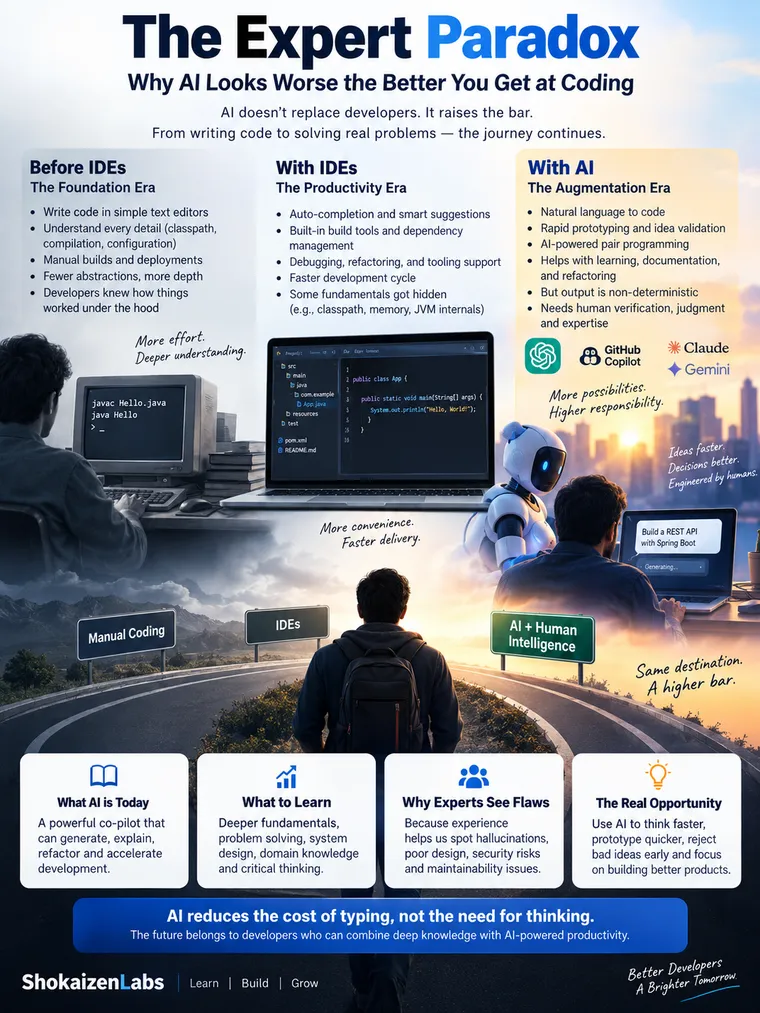
What Software Engineers Actually Need to Get Better at in the AI Era
There’s a lot of noise happening in tech right now. Every company management is saying “AI First,” push everything through AI. And on the other side, developers are genuinely worried — like, is my job even going to exist in two years?
But if you sit and talk to senior engineers, people who’ve been coding for 20-30 years, you’ll notice something interesting. They’re not that impressed. And it’s not because they’re old-fashioned or scared of new tech. There’s a real reason behind it, and once you understand it, it changes how you use AI in your own work.
Why Your Skill Level Decides How “Amazing” AI Looks
For decades, software has worked in a very predictable way. A + B always gives you C. No surprises. Compilers don’t have off days.
AI has changed this. It gives output that looks brilliant, but whether it’s actually correct is a separate question entirely. And here’s the interesting part: how impressed you are by AI depends completely on how much you already know about that topic.
Ask AI to do something you’re a complete beginner at, and it’ll blow your mind — you won’t even notice the mistakes because you don’t know enough to spot them. But ask it to do something you’re actually good at, and suddenly you see all the problems: bad logic, messy structure, the same silly mistakes junior developers make.
So AI isn’t just generating code, it’s exposing how much you can actually verify on your own. The skill that matters now isn’t “can you generate code fast” — it’s “can you tell if this code is even right.”
Think First, Then Bring AI In
If verification is the real skill now, jumping straight to ChatGPT or Claude the moment you see a problem is actually a bad habit. You skip the part where the problem properly sinks into your brain.
A better way to work:
- Sit with the problem yourself first. 15 minutes, no tools, just think.
- Talk to your team. A colleague catches things AI misses.
- Then bring AI in. Treat it as one more input, not the first and only one.
In one real test, developers solved a problem on their own first, then ran the same problem through a few different AI models. The developers spotted things AI completely missed, and AI flagged risks the developers hadn’t thought about. Together, it was better than either side working alone.
Shovels vs. Cranes — Why AI Needs More Skill, Not Less
Picture 50 labourers standing in a pond, forming a human chain, manually clearing silt. Hard physical work, but low skill — one guy drops his shovel, nothing much happens, the chain keeps going.
Now picture the same job done by 2 people using a crane. Manpower drops from 50 to 2, but the skill needed per person goes up massively. A labourer dropping a shovel — no big deal. An untrained crane operator pressing the wrong button — that causes serious damage.
That’s what’s happening with AI in software. AI is the crane, not the shovel. It’s not lowering the bar for skill — it’s raising the cost of not having skill. You need fewer people, but each person needs to understand a lot more about what “correct” actually looks like.
Where AI Actually Helps — Proving Bad Ideas Are Bad, Fast
One of the most underrated uses of AI isn’t writing final code — it’s proving quickly that an idea won’t work.
Normally, convincing your team that an approach is wrong takes forever — meetings, back and forth, politics. Building a prototype to make your point used to cost too much time, so people didn’t bother. Now you can build a rough version of an idea in minutes, show the team, and everyone sees why it won’t work before weeks get wasted on it.
That’s a shift from “how much code did I type” to “how fast can the team make a good decision” — and the second one is what actually moves a project forward.
Before IDE vs. After IDE — Don’t Let Tools Hide Your Basics
Old-school developers had no choice but to understand what’s happening behind the scenes — classpath, build process, memory — because no tool was hiding that complexity from them.
Modern IDEs changed that. They manage dependencies automatically. Frameworks hide the wiring. Now AI can write full functions without you touching what’s underneath. The problem isn’t the tool — it’s what happens when you never learn what the tool is doing for you. There are real cases of full-time developers not knowing what a classpath is, simply because the IDE always hid it.
There’s a difference worth remembering here: studying vs learning. Studying is something you do because you have no choice — finish it, move on. Learning is something you do out of curiosity, and that’s what actually sticks. AI speeds up either one. If you’re only studying — copy the AI’s answer, move on — your skills quietly get weaker over time. If you’re actually learning — asking why AI suggested this, is it correct, what would I have done differently — AI becomes a real accelerator.
This is also why bad incentives around AI backfire. When companies push output numbers instead of quality — bonuses tied purely to bug counts, for instance — people find ways to game the system rather than actually get better. It’s the same root issue: measuring the wrong thing pushes people toward studying-for-the-test instead of genuinely learning, and that gap always shows up eventually.
Three Things to Actually Try This Week
- Before accepting an AI suggestion, pause for 60 seconds and ask “why did it do this, and is it correct?” — don’t just accept and move on.
- Time-box one real problem this week. Give yourself 15 minutes to think it through alone before opening any AI tool.
- Next time AI gives you code in something you already know well, actively look for what’s wrong with it — not to dismiss the tool, but to calibrate how much you should trust it on things you don’t know well.
The Bottom Line
Look at how Java itself has evolved — lambdas and streams in Java 8, virtual threads more recently. None of these became successful because they added a flashy feature other languages already had. They worked because they kept the code simple for the developer while quietly handling the hard stuff underneath — letting engineers delay tough decisions to the “last responsible moment.” That’s good engineering thinking, with or without AI.
AI is driving the cost of typing code down to almost zero. But it’s not driving the cost of judgment, verification, or architectural sense down — if anything, those skills matter more now, not less.